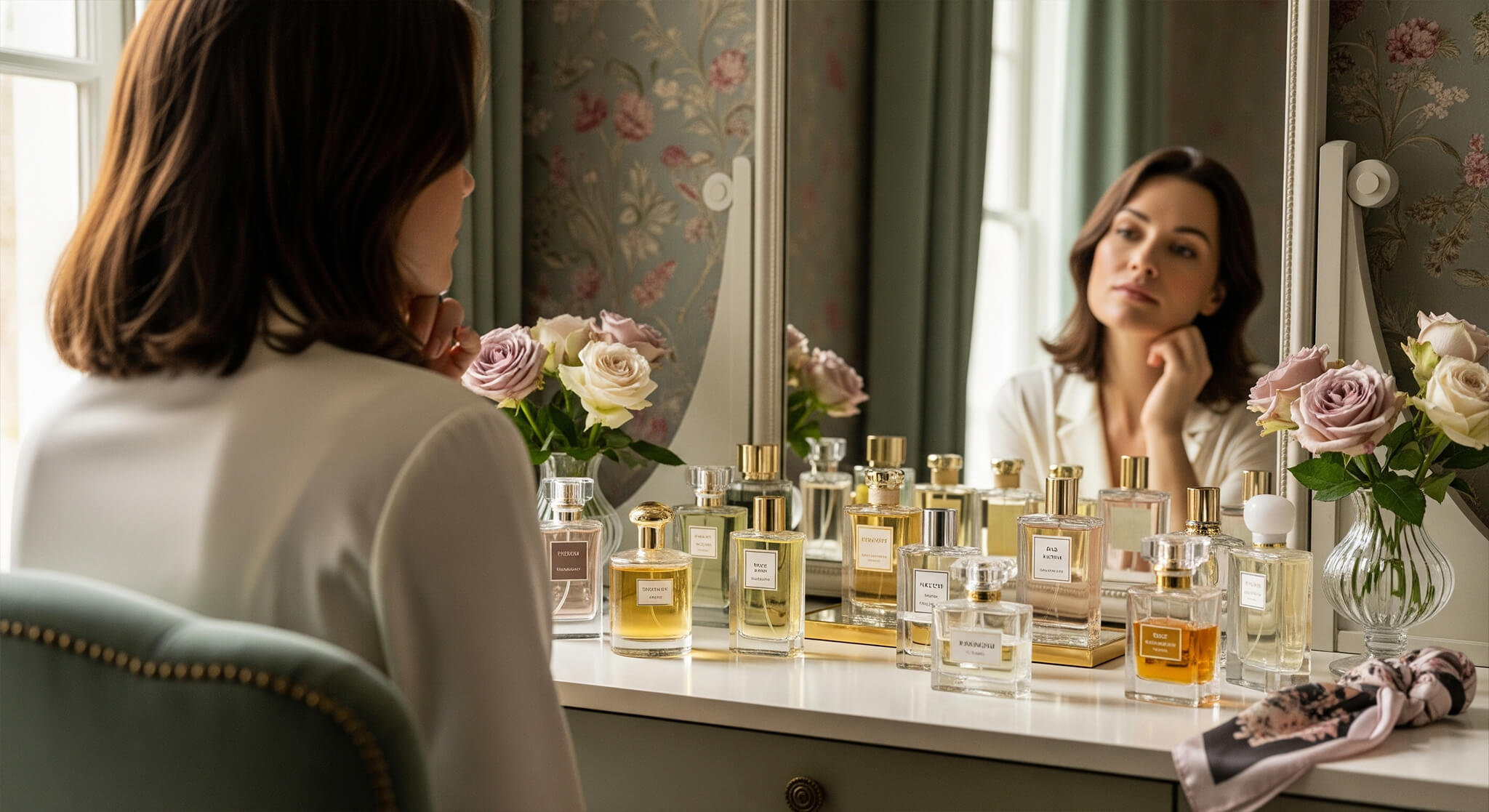
Introduction: The Olfactory Business Card
By definition, a signature scent is a fragrance worn with such consistency that it becomes an integral component of an individual's personal identity. It is the specific aroma that people "typically associate with you", a powerful, invisible marker of your presence. For those who have found theirs, leaving the house without it can feel akin to being partially undressed, like forgetting a core part of oneself.
This guide explores the signature scent not as a mere accessory, but as a potent form of non-verbal communication and a deeply personal psychological anchor. It is an "olfactory business card", an "invisible trademark" that precedes an introduction and "leave[s] a lasting impression after you've gone". It is a tool with the profound power to make one "unforgettable".
This document serves as a definitive guide to this complex concept. It will move from the profound neuroscience of why scent commands such power over our minds, to the technical lexicon of perfumery, to a practical methodology for discovering a personal scent. Furthermore, this analysis will explore the modern cultural trends challenging the very idea of a single signature, and conclude with a practical case study for the fragrance connoisseur navigating the specialized market of Amsterdam.
Part I: The Scented Mind: The Psychological Mandate for a Signature
The human desire for a signature scent is not a frivolous pursuit. It is a biological and psychological mandate, rooted in the unique, primal architecture of the human brain.
Subsection 1: The Proustian Mandate: Neuroscience of Scent & Memory
The power of olfaction is a matter of neuro-architecture. Smells are processed by the olfactory bulb, a structure in the front of the brain that sends information to the rest of the body's central command. This system has a unique, "direct route"—an unfiltered superhighway—to the brain's limbic system. This includes the amygdala, the brain's primary emotion center, and the hippocampus, its memory hub.
Unlike information from sight, sound, or touch, scent does not first pass through the thalamus, which acts as the brain's sensory switchboard or gatekeeper. This lack of filtration means olfactive information is raw, immediate, and deeply intertwined with emotion and memory. This is why, as neuroscientists explain, "smell and emotion are stored as one memory".
This neurological "hardwiring" is the basis for the "Proustian Memory Effect". This phenomenon, named for Marcel Proust's description of a tea-soaked madeleine evoking a flood of childhood memories, describes how a scent can trigger a more emotional, visceral, and transportative autobiographical memory than any other sensory cue. A signature scent leverages this powerful, subconscious mechanism. It becomes "part of your identity, something that lingers in the minds of those you encounter", forging an indelible link between your presence and the emotional centers of another's brain.
Subsection 2: The Psychology of Olfactory Identity
This neuroscientific reality has profound psychological implications. A signature scent becomes a primary tool for "self-expression," operating on the same level as one's choice of clothing, accessories, or hairstyle. It is a deliberate method to "show the world who you are", reflecting and projecting a chosen personality, whether "playful, serious, contemplative, or feminine".
Fragrance is also a proven and powerful confidence-builder. This effect is twofold. Externally, it serves as a projection of identity, an invisible "aura" of your intention. Internally, it functions as an emotional anchor. The simple act of spraying a scent linked to positive, happy memories "can bring you back to your happy place", measurably reducing stress, improving mood, and calming the mind.
Your fragrance, whether you realize it or not, "is telling a story about you before you even open your mouth". Different olfactive notes project distinct narratives. Soft florals can convey "romance and elegance". Warm vanilla and musk can project "warmth and comfort," making one feel more approachable. Woody and leather notes can exude "confidence and sophistication". This non-verbal storytelling has tangible social consequences; research has shown that being surrounded by pleasant scents can even increase "prosocial behaviors"—such as helpfulness and support—from strangers.
Subsection 3: Atmospheric Inheritance: Scent as a Cultural & Familial Legacy
These powerful scent preferences are not formed in a vacuum. They are deeply imprinted during childhood, the period in which humans create "the basis for smells you will like and hate for the rest of your life". The brain is innately drawn to scents it has previously associated with positive memories, comfort, and, on a primal level, "safety".
This imprinting often begins as a "sensory legacy" within the family. The specific perfume worn by a parent or grandparent can "become a comfort scent" or function as a "family heirloom", providing a tangible, sensory bridge to the past and a feeling of continuity. This concept of "atmospheric inheritance" explains how scent preferences are passed down, not biologically, but culturally and emotionally.
This legacy extends to broader culture. Different societies prize different notes, embedding them with specific meanings. In many Middle Eastern cultures, for instance, oud and musk are prized for their richness and complexity, symbolizing luxury and tradition. In France, perfume is introduced as an "integral part of life" from a young age, often centered on spicy notes, citrus, and florals. In the United States, preferences often lean toward the familiar, sweet, and comforting notes of vanilla and fruit.
This deeply rooted imprinting means that the "discovery" of a signature scent is often a misnomer. It is, in fact, a process of re-discovery. The consumer is not choosing a new scent from a blank slate. They are, consciously or not, on an archaeological dig for a set of molecules their brain has already cataloged under "happiness," "comfort," or "identity." The search for a signature scent is a search for an external validation of an internal, pre-existing emotional map.
Part II: A Perfumer's Lexicon: Deconstructing the Elixir
To find a signature scent, one must first learn its language. The world of perfumery is built on a technical vocabulary that describes the architecture, character, and performance of any fragrance.
Subsection 1: The Olfactory Families: A Connoisseur's Guide
The industry-standard classification system is the "Fragrance Wheel," a concept developed by fragrance expert Michael Edwards. This wheel functions like a "color wheel" for olfaction, organizing the vast world of scents into related groups. While this system branches into many sub-families, it is built upon four primary pillars.
- Floral: The most common and diverse family, characterized by dominant notes derived from flowers such as rose, jasmine, lily, gardenia, and neroli. Floral scents can range from "soft and romantic" to powdery, to opulent and heady. This family includes sub-families like Fruity Floral, which adds notes of peach or berries, and Soft Floral, which includes powdery notes like iris.
- Woody: These scents are warm, earthy, and opulent. They are built on notes like sandalwood (creamy and rich), cedarwood (dry and sharp), vetiver (smoky and grassy), and patchouli (earthy and sweet). These fragrances are often perceived as "darker, sultrier" and sophisticated. Sub-families include Mossy Woods (e.g., oakmoss) and Dry Woods (e.g., leather).
- Amber (or Oriental): These two terms are now used largely interchangeably to describe this family. This family is defined as "sensual," warm, "exotic," and rich, often with a powdery or spicy character. It is built on notes of resins, herbs, spices, vanilla, and musk. Sub-families include Soft Ambery (which includes incense) and Woody Ambery.
- Fresh: This is a broad category encompassing clean, crisp, and "invigorating" scents. It is composed of several major sub-families: Citrus (e.g., lemon, bergamot, orange), Green (e.g., fresh-cut grass, herbs), and Aquatic/Water (e.g., sea breeze, rain).
Subsection 2: The Perfume Pyramid: An Unfolding Narrative
A fragrance is not a static, monolithic block of scent. It is a "multi-layered symphony that evolves over time" as its different components evaporate from the skin. This planned evolution is known as the perfume pyramid, a three-act structure.
- Top (Head) Notes: These constitute the "first impression" of the fragrance. They are composed of light, "volatile" molecules that evaporate quickly, typically lasting only the first 5 to 15 minutes after application. They are designed to be bright, uplifting, and attention-grabbing, often featuring fresh, citrus, or green notes.
- Middle (Heart) Notes: These notes represent the "core personality" and "heart of the fragrance". They "emerge once the top notes begin to fade" and form the main body of the scent, lasting from 20 minutes to a few hours. These are typically well-rounded floral, spicy, or fruity notes that provide balance and character.
- Base (Bottom) Notes: These are the "lasting memory" and the "anchor" of the scent. They are composed of heavy, dense molecules that evaporate very slowly, lingering on the skin for six hours or more. This final, lingering stage is known as the "dry-down" and reveals the "true scent" or "body" of the perfume. Base notes are typically deep and rich, such as musk, woods, amber, and vanilla.
It is a common misconception that these notes "come and go" in sequence. In reality, all notes are present from the first spray. They simply "evaporate at their own pace" according to their "specific vapor pressure". The art of perfumery is to compose this "symphony" so that the blend is harmonious at every stage of its long, fading narrative.
Subsection 3: A Guide to Concentration: Parfum, EDP, EDT
Fragrances are categorized by their concentration level—the percentage of pure "fragrance oil" (the aromatic compounds) to a solvent, which is usually alcohol. This ratio is the primary factor dictating the scent's longevity, its projection (known as "sillage," or the scent trail it leaves), and its price point.
While these tiers provide a general guide, it is critical to note that these terms and percentages are not regulated by any international standard. They are, in effect, marketing terms. One house's "Eau de Toilette" may have higher-quality ingredients and better longevity than another's "Eau de Parfum". Nonetheless, the general hierarchy is an essential piece of the lexicon.
Table: Fragrance Concentration Levels: A Guide to Potency and Longevity
|
Fragrance Type |
Fragrance Oil % |
Typical Longevity |
Characteristics |
|
Parfum / Extrait de Parfum |
20-40% |
8-24 hours |
The highest concentration. Most expensive and longest-lasting. The scent is rich, deep, and tends to stay closer to the skin.[28, 37, 38] |
|
Eau de Parfum (EDP) |
15-20% |
4-8 hours |
The most popular modern concentration. Considered the "gold standard," balancing intensity, longevity, and value.[28, 37, 38, 39] |
|
Eau de Toilette (EDT) |
5-15% |
2-4 hours |
A lighter, less intense composition. Often suitable for everyday wear, office environments, or warmer weather.[28, 36, 37, 38, 39] |
|
Eau de Cologne (EDC) |
2-5% |
1-3 hours |
Traditionally a very light, refreshing, and citrus-based formulation used as a splash.[28, 38, 39] |
|
Eau Fraîche |
1-3% |
1-2 hours |
The most diluted form of fragrance, offering a fleeting, refreshing burst of scent.[28, 37, 38] |
Part III: The Alchemist's Journey: A Practical Guide to Scent Discovery
Finding a signature scent is a patient, methodical experiment. It is an alchemical process where your own skin is the chief, and most unpredictable, variable.
Subsection 1: Phase 1: Identifying Your Olfactive Profile
Before smelling a single blotter, the first step is introspection. The first rule is to trust your own instincts and preferences, not trends. A true signature scent must align with the totality of your life. Key questions to consider include:
- Personality: What is the "mood" or "vibe" you wish to project? Are you romantic, professional, artistic, or minimalist?.
- Lifestyle: Where will this scent be worn? A "corporate environment" often demands a "fresh/clean" and less overpowering scent. A lifestyle centered on creative pursuits or evening events may allow for "darker, sultrier" or more complex fragrances.
- Versatility: A true signature should be appropriate for "most situations" and wearable through "most seasons". This versatility is often what distinguishes a "signature" from a "date night" scent.
Subsection 2: Phase 2: The Science of Skin (Testing Methodology)
Once a general profile is established, the testing begins. The guiding principle is: "Test, Don't Guess".
- Skin, Not Paper: Testing on paper blotters is only for an initial screening—to quickly eliminate non-contenders. The final, deciding test must be on skin.
- The Litmus Test: "Your skin chemistry ultimately determines how a fragrance smells and evolves". Your skin's unique pH, temperature, and level of oiliness can fundamentally alter a perfume's notes. Sweat can also disrupt a scent's development. A perfume is an inert substance on paper; on skin, it is one half of a chemical reaction.
- Correct Application: Apply the fragrance directly to "pulse points". These are the warmest areas of the body, where blood flow is closest to the surface, and they act as natural diffusers to "amplify" and "pronounce" the scent. Key points include the wrists, the nape of the neck, behind the ears, and the inner elbows.
- The Cardinal Sin:Do NOT rub your wrists together. This is the most common and destructive mistake made in perfume testing. Rubbing "breaks up," "crushes," and "damages" the delicate top and middle note molecules. This friction generates heat, which accelerates evaporation and disrupts the perfumer's intended, careful "dry-down" process, causing the scent to fade faster and smell "off".
- Preparation: Fragrance "clings" to emollients and moisture. If you have dry skin, the volatile oils will evaporate very quickly. To properly "anchor" the scent and get a true test of its longevity, apply an unscented moisturizer or a thin layer of Vaseline to the pulse point before spraying.
- Avoid Olfactory Fatigue: The human nose quickly becomes desensitized. Do not test more than "1–3 scents at a time" to avoid overwhelming your senses and losing the ability to distinguish between them.
Subsection 3: Phase 3: Mastering the "Dry-Down"
This is the most crucial, and most frequently ignored, phase of testing. The consumer's greatest enemy in the perfume hall is impatience. The entire retail experience is designed around the "first impression"—the dazzling, volatile top notes that last only minutes. This is a marketing trap.
The critical advice is to "wait for it to dry down". A perfume you love in the first 10 minutes (the top notes) may transform into a base-note-driven scent you dislike after an hour. The "dry-down" is the period when the heart and base notes emerge, revealing the "true scent," "body," or "soul" of the perfume. This is the scent that will actually live with you for the next 6 to 8 hours. The dry-down is the perfume.
Be patient. The true character of a scent "unfold[s] over several hours". A simple citrus scent may reveal its base in 20 minutes, but a complex woody or amber fragrance can take "60 to 90 minutes" to show its true colors. The "final evaluation to determine if a fragrance is right for you" is the aroma on your skin hours after you have left the store. This requires transforming oneself from a passive target of marketing into an active, discerning scientist—testing the unique chemical reaction that is the only test that matters.
Part IV: The Modern Olfactive Landscape: Redefining "Signature"
In the contemporary cultural landscape, the very concept of a single, lifelong "signature scent" is being fundamentally challenged. This shift is driven by a new philosophy of personal expression, fluidity, and curation.
Subsection 1: The Great Debate: A Single Signature vs. The Scent Wardrobe
There are "two schools of thought" regarding personal fragrance.
- The Signature Scent: This is the traditional, "monogamous" approach. Its virtues are consistency, personal branding, and recognizability. It is the ideal for the "minimalist" who values a streamlined, reliable "olfactory business card".
- The Scent Wardrobe: This is the modern, flexible approach. A "scent wardrobe" is a curated "collection of scents you rotate and reach for depending on the season, your mood, or the occasion".
The central critique of the single-signature concept is that it is "limiting". Proponents of the wardrobe ask: why should one wear the same fragrance to a board meeting, a casual brunch, and a formal gala?. As one expert notes, "one singular perfume" cannot "accurately portray my kaleidoscopic existence... We, as humans, contain multitudes".
The modern compromise for most enthusiasts is the "signature scent wardrobe"—a small, curated rotation of 3-5 "workhorse" favorites that serve as personal signatures for different contexts, such as a season or time of day.
Subsection 2: The Niche Revolution & The Rise of Gender-Fluid Fragrance
The "scent wardrobe" concept has been fueled by the explosion of "niche fragrances". Unlike mass-market designer perfumes, niche scents are typically "created in small batches," often utilize "rare ingredients," and are built around "artistic inspiration" rather than mass appeal. Crucially, "they are not meant to please everyone".
Niche houses, such as Le Labo, Byredo, and Diptyque, pioneered the rejection of the "For Him" / "For Her" binary that dominated 20th-century fragrance marketing. They focused instead on "storytelling" and "conceptual inspiration," naming scents after places, materials, or memories.
This philosophy aligns perfectly with a major consumer shift, driven by Gen Z and Millennial buyers, who "increasingly view traditional gender categories in perfume as outdated". This demographic prioritizes the scent profile itself over gendered marketing. This is not merely a coastal trend; it is a market takeover. Gender-neutral fragrances now account for "nearly 40% of premium fragrance sales," a dramatic increase from less than 15% just five years prior. This shift is, in fact, a return to perfumery's roots; the rigid gender binary was a 20th-century marketing invention, whereas historically, perfumes were inherently unisex.
Subsection 3: The New Minimalism: Molecular "Skin Scents"
A key 2025 trend is the rise of "Clean, Skin-Centric Scents". These are "molecular perfumes," minimalist fragrances often composed of a "single molecule or a few molecules" rather than a complex pyramid.
Their entire function is different from traditional perfume. They are not designed to "mask" but to react with and enhance the wearer's unique, natural skin chemistry. They "emphasize one's own body odor" to create a "your-skin-but-better" effect.
The icon of this category is Molecule 01 by Escentric Molecules. Its sole ingredient is the synthetic molecule Iso E Super. This fragrance is famous for causing "olfactory fatigue" in the wearer (who often cannot smell it on themselves), while being "subtle, but at the same time intriguing" to others, often described as a "soft, velvety wood scent". Other popular examples of this philosophy include Glossier You and PHLUR Missing Person.
Subsection 4: 2025 Trend Briefing
Beyond molecular scents, the current fragrance landscape is defined by several other key movements:
- Sophisticated Gourmands: The "gourmand" trend (edible, dessert-like notes) is "still going strong" but is "getting more sophisticated". The cloying sweetness of the past is being balanced with "dry woods, amber, or smoky hints". A prime example is Kilian's Love, Don't Be Shy, a cult favorite with notes of marshmallow and amber.
- Spicy & Woody Blends: Driven in part by celebrity influence, "spicy, woody blends" are dominant. Tom Ford's Santal Blush, with its blend of cinnamon and creamy sandalwood, is a key scent defining this cozy, confident trend.
- Nature & Nostalgia: In a post-pandemic world, there is a strong consumer desire for "scents that reconnect us to natural rhythms" (e.g., moss, rain, fig leaf) and fragrances that "evoke cherished moments" and tell a nostalgic story.
- Intense Formulations: There is a clear "desire for stronger perfumes this season". This is evidenced by the commercial success of "Intense" and "Parfum" flankers (stronger, deeper variations of existing popular scents), such as Yves Saint Laurent's Libre Intense.
These movements—the Scent Wardrobe, the Niche Revolution, Gender-Fluidity, and Molecular Scents—are not four separate trends. They are four reinforcing pillars of one single macro-trend: the profound cultural shift from prescriptive luxury to expressive identity. In the 20th century, a legacy brand told the consumer what a powerful or sensual person smelled like, and the consumer bought the perfume to aspire to that image. In the 21st century, the consumer demands products that are tools for co-creation. A scent wardrobe allows for a fluid identity. A gender-fluid scent rejects an imposed binary. A molecular scent is literally incomplete until it reacts with the wearer's skin. The consumer is no longer a passive recipient of a brand's "signature"; they are an active creator of their own.
Part V: An Olfactive Library: Iconic & Niche Examples
To make the abstract concepts of the fragrance families concrete, this section provides a curated library of real-world fragrances, categorized by their primary family and status.
Table: A Curated Library of Iconic and Niche Fragrances by Family
|
Fragrance Family |
Iconic/Designer Example |
Niche/Artisanal Example |
Olfactive Profile / Key Notes |
|
Floral |
Dior J'adore [75] |
Frédéric Malle Carnal Flower [76] |
J'adore (Modern Floral Bouquet); Coco Mademoiselle (Rose, Jasmine, Orange, Patchouli); Carnal Flower (Heady, photorealistic Tuberose); Rose of No Man's Land (Clean, crisp Turkish Rose) |
|
Woody |
Dior Fahrenheit [77] |
Le Labo Santal 33 [77, 78] |
Fahrenheit (Cedar, Violet, Leather); Santal 33 (Sandalwood, Cardamom, Violet, Papyrus); Oud Wood (Rare Oud, Rosewood, Sandalwood) |
|
Amber (Oriental) |
Guerlain Shalimar |
Maison Francis Kurkdjian Grand Soir [80] |
Shalimar (Bergamot, Iris, Vanilla, Amber); Grand Soir (Deep Amber, Benzoin, Vanilla); Black Orchid (Truffle, Patchouli, Vanilla, Dark Chocolate) |
|
Fresh (Citrus/Aquatic) |
Dolce & Gabbana Light Blue [81] |
Tom Ford Neroli Portofino [81] |
Light Blue (Sicilian Lemon, Apple, Cedar); Neroli Portofino (Italian Neroli, Bergamot, Lemon); Orange Sanguine (Photorealistic Blood Orange, Geranium) |
|
Gender-Fluid / Molecular |
CK One [65, 82] |
Escentric Molecules Molecule 01 [67, 74] |
CK One (Bergamot, Green Tea, Musk); Molecule 01 (Pure Iso E Super - velvety wood); Glossier You (Pink Pepper, Iris, Ambrette - a "skin scent") |
The process of categorizing these fragrances reveals a critical nuance. The "families" are not rigid, mutually exclusive boxes but overlapping themes. The most iconic and complex scents often defy easy classification. For example, Chanel Coco Mademoiselle is variously classified by experts as a Floral (for its jasmine and rose heart) , an Amber/Oriental (for its rich patchouli and vanilla base) , and even a Citrus (for its bright orange opening). This is not a contradiction. It demonstrates its complex "Chypre" structure, which masterfully bridges all three families, and proves that the most timeless creations often transcend simple labels.
Part VI: The Rituals of Scent: Application and Preservation
Owning a fine fragrance is an investment. Protecting that investment requires specific knowledge of application, to maximize performance, and storage, to preserve its delicate chemical integrity.
Subsection 1: Maximizing Longevity: A Best-Practice Application Guide
A fragrance's performance is not just about its concentration; it is heavily dependent on how it is applied.
- The Canvas: Always apply fragrance to bare skin. The ideal time is immediately after a shower, onto warm, clean, and thoroughly dry skin.
- The #1 Technique: Moisturize First. This is the most effective technique for extending a scent's life. "Fragrances cling to emollients". Dry skin causes the volatile oils to evaporate quickly. To give the perfume molecules something to "lock onto" , first apply an unscented body lotion, cream, or a small dab of Vaseline to your pulse points.
- The Targets: Pulse Points. Apply the scent to the warmest parts of your body, which act as natural diffusers. These include the wrists, the nape of the neck, behind the ears, the inner elbows, and even the backs of the knees.
- The Cardinal Sin: Do Not Rub. Never rub your wrists together after spraying. This common habit "crushes" the delicate top and middle notes , "breaks down" the molecules , and prematurely heats the fragrance, muddling the intended dry-down and causing the scent to fade significantly faster.
- The Finish: Let the perfume air-dry naturally on the skin before dressing. For an extra "aura," spray your hairbrush (not your hair directly, as the alcohol can be drying) and brush it through.
Subsection 2: Preserving the Elixir: How to Properly Store Your Collection
A bottle of perfume is a delicate, volatile chemical compound. Its three mortal enemies are Heat, Light, and Humidity.
- The Worst Location: The Bathroom. This is the single biggest mistake consumers make. Never store perfume in the bathroom. The constant, fluctuating "humidity and temperature variations" from showers and baths will rapidly "oxidize" and "degrade" the delicate essential oils. This breaks down the formula, altering the color and causing the scent to "smell off".
- The Ideal Location: The perfect storage spot is a "cool, dark, dry place" with a stable temperature. The best and most practical options are a dresser drawer, a bedroom "closet or cabinet", or, for maximum protection, its original box. While some suggest a refrigerator, this is generally unnecessary unless you are archiving a scent for decades.
- Best Practices: Always replace the cap tightly to prevent oxidation from the air. Store bottles upright, as some stopper designs can leak if laid flat. Finally, do not shake the bottles; this introduces air and accelerates degradation.
There is a fundamental conflict between how perfume is marketed—as a beautiful, sculptural art object to be displayed on a sunlit vanity —and how its chemistry must be preserved. The modern "shelfie" culture reinforces this desire for display. However, the chemical data is immutable: light and humidity are poison to perfume. The most crucial advice for protecting a multi-hundred-dollar investment is to ignore the aesthetic trend and treat the bottle as a light-sensitive tool, not as decor.
Part VII: Case Study: A Fragrance Connoisseur's Guide to Amsterdam
For the fragrance enthusiast visiting Amsterdam, the city offers a rich, multi-tiered ecosystem of olfactive experiences. This landscape can be navigated based on the consumer's primary intent: mainstream access, niche curation, or bespoke creation.
Subsection 1: Tier 1 (Curation): The Niche Boutique Experience
For the consumer who wishes to discover a unique, existing scent from a curated, world-class library.
- Skins Cosmetics: This is the premier destination in Amsterdam for "niche international... fragrance brands". As an exclusive importer for many labels, Skins offers a selection "that you won't find elsewhere". The staff is known for providing "expert advice" and "premium samples". Key brands include Kilian, Maison Crivelli, Diptyque, Byredo, Le Labo, and Salle Privée.
- Perfume Lounge: Established in 2009, this is the original "go-to destination for niche fragrance lovers" in the city. It is a true boutique experience, deliberately located away from busy shopping streets to house a "downstairs lab, a library, a scent garden". It is the place to discover more artisanal houses like Satori, Nicolai Paris, Strangelove NYC, and The Zoo.
- Babassu Beauty: A cosmopolitan lifestyle concept store that features "iconic brands with a story". Its niche perfume selection includes coveted brands like BDK Parfums, Miller Harris, Nissaba, and Lorenzo Villoresi.
Subsection 2: Tier 2 (Consultation & Creation): The Bespoke Journey
For the consumer who wants to go deeper, either finding their perfect scent through expert guidance or creating an entirely new one.
- Consultation: "Perfume Profiling" at Perfume Lounge: This is a guided discovery service. For a fee, a
client receives a "thorough personal one-on-one session" with a
perfume expert. The expert analyzes the client's tastes and character to
help them discover and "curate a fragrance wardrobe" from the
boutique's extensive collection.
- Price: €125 for a solo "Perfume Profiling" session or €230 for a "Duo Profiling" session.
- Workshop: Scents Design Studio (with Aleksandra): This is a hands-on creation workshop. Led by a
fragrance expert with over 20 years of experience, this 3-hour session
allows participants to learn about and smell over 50 high-quality raw
materials. Each participant will then "design and compose" their
own unique 30ml or 50ml perfume to take home in a luxury bottle with a
personalized label.
- Price: Varies by session type, from €145 per person for a group session to €180 for a private one-on-one workshop.
- Workshop: Liza Witte: This
"intensive 4 hour Perfume Workshop" is held in an Amsterdam
atelier for small groups (3-7 people). The workshop focuses on composing a
scent from over 35 natural and synthetic perfume materials, with each
participant creating their own 10ml perfume to take home.
- Price: €110 per person.
Subsection 3: Tier 3 (Mainstream): The Department Store Landscape
For the consumer seeking established designer or mainstream luxury brands.
- De Bijenkorf: As Amsterdam's "premium department store chain," the flagship location on Dam Square is the primary destination for mainstream luxury. The large, ground-floor perfume hall features a wide array of high-end international labels, alongside a "beauty salon".
- Schiphol Airport (Today Duty Free): For the international traveler, the duty-free shops at Schiphol offer a large collection of international brands, with the benefit of "expert personal beauty advice" available in the main lounges.
Concluding Report: Crafting Your Olfactive Legacy
This report has explored the signature scent as a concept far deeper than a simple accessory. It is the "olfactory business card" we issue to the world, a "sensory legacy" crafted from the neurological building blocks of our most cherished memories and brought to life through the unique alchemy of our own skin chemistry.
The modern fragrance landscape offers a profound choice. One can embrace the loyal, timeless consistency of a single signature scent, becoming known and remembered for one specific, comforting aroma. Or, one can curate an expressive, "kaleidoscopic" scent wardrobe, selecting a fragrance each day to reflect a different mood, season, or facet of a complex identity.
Ultimately, whether you choose a single signature or a rotating wardrobe, the journey of discovery is the reward. The goal is not merely to smell good, but to find and wield this powerful, invisible medium to tell your own story, communicating your identity "before you even open your mouth".
References
- https://news.harvard.edu/gazette/story/2020/02/how-scent-emotion-and-memory-are-intertwined-and-exploited/#:~:text=Smells%20are%20handled%20by%20the,related%20to%20emotion%20and%20memory.
- https://pmc.ncbi.nlm.nih.gov/articles/PMC4330889/
- https://sylvaia.com/